
Prelaunch analysis · Reporting checked November 7, 2026 (UTC). Flight dates and recovery plans can change.
The most consequential moment of SpaceX’s next Starship launch may come long after the rocket disappears into the sky: the moment its upper stage comes back from orbit and is safely recovered, with the Super Heavy booster already back on Earth.
If both stages return intact, the achievement could mark a pivotal step in humanity’s access to space. The reason reaches beyond the spectacle of catching a rocket. It would demonstrate a path toward keeping the two main powered stages of an orbital launch system available for another mission, rather than manufacturing a replacement upper stage for each trip.
The next test is Starship Flight 15. Musk has said SpaceX intends to attempt tower catches of both Super Heavy and the Starship upper stage. Launch trackers currently list no earlier than November 13, 2026, with the time still to be confirmed. These are prelaunch plans, not completed accomplishments. Musk’s November 6 statement, archived, Next Spaceflight’s live mission tracker
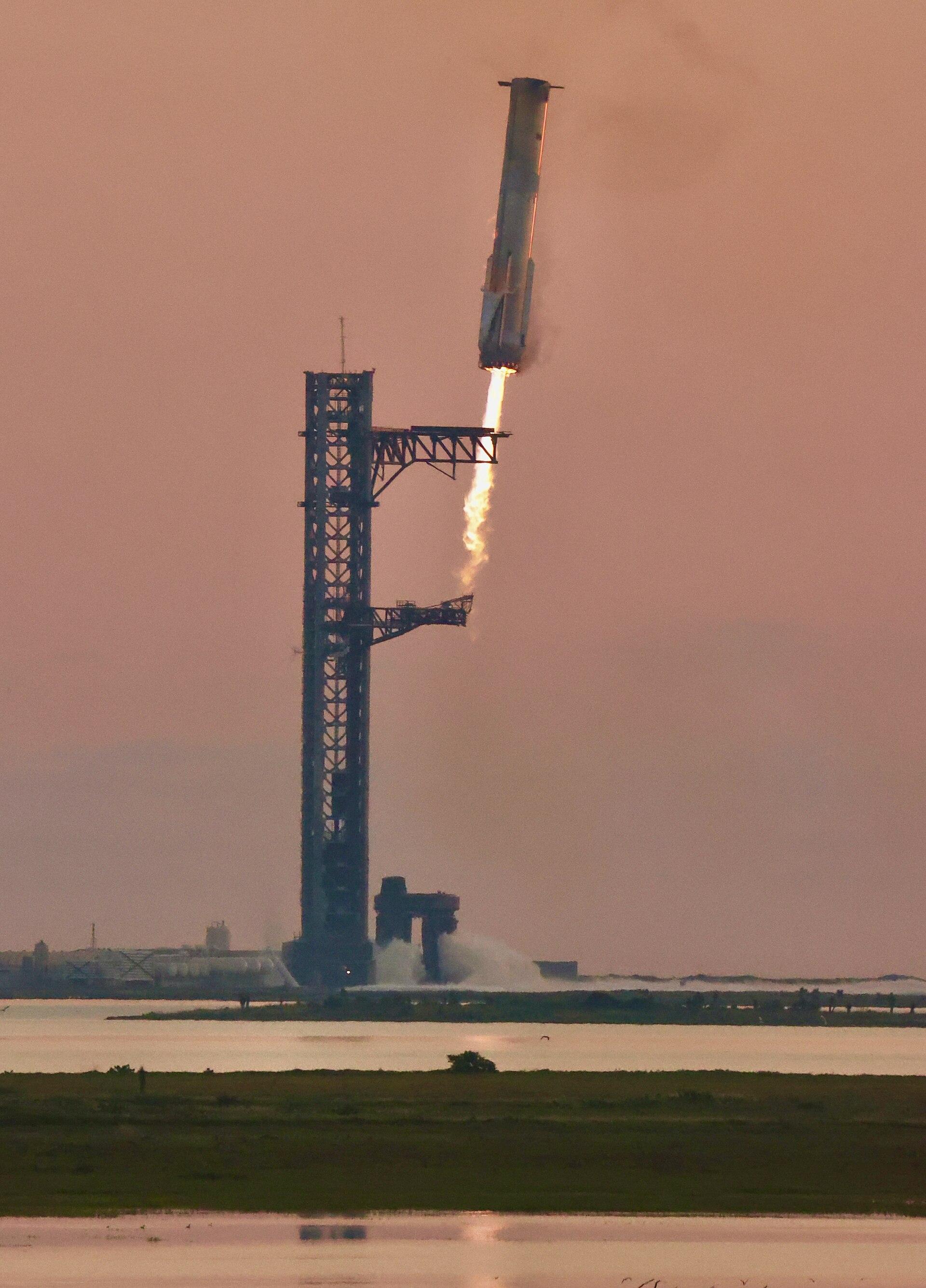
Super Heavy approaches the tower during Flight 5 on October 13, 2024. This historical photograph illustrates the recovery technique; it does not show Flight 15. Photo: Steve Jurvetson, CC BY 2.0; resized for publication.
The breakthrough is bringing the upper stage home, too
Starship has two main stages. Super Heavy provides the initial thrust, then separates. The Starship upper stage, often called “Ship,” continues toward orbit and carries the payload. Recovering each presents a different problem.
SpaceX first caught a Super Heavy booster with the launch tower’s mechanical arms during Flight 5 in October 2024. Its own account emphasizes that thousands of vehicle and ground-system criteria had to be satisfied before the catch could proceed. Returning near a tower is therefore a tightly controlled operation, with safety checks governing whether an attempt goes ahead. SpaceX’s Flight 5 report
The upper stage faces the additional challenge of returning from orbital speed. ESA describes typical speeds near atmospheric reentry as roughly 28,000 kilometers per hour. The spacecraft must shed that energy, withstand heating, remain controllable and arrive at the recovery site with the precision needed for a safe capture. A successful booster catch does not by itself prove that the upper stage can do all of those things. ESA’s explanation of reentry
Reaching orbit is already a separate milestone: SpaceX’s third-quarter report records Flight 14 as its first orbital Starship mission, delivering 26 Starlink V3 satellites. Flight 15’s proposed recovery attempt would address the next part of the journey—bringing the orbital vehicle back in a condition that makes reuse possible. SpaceX’s official Q3 2026 report, page 4
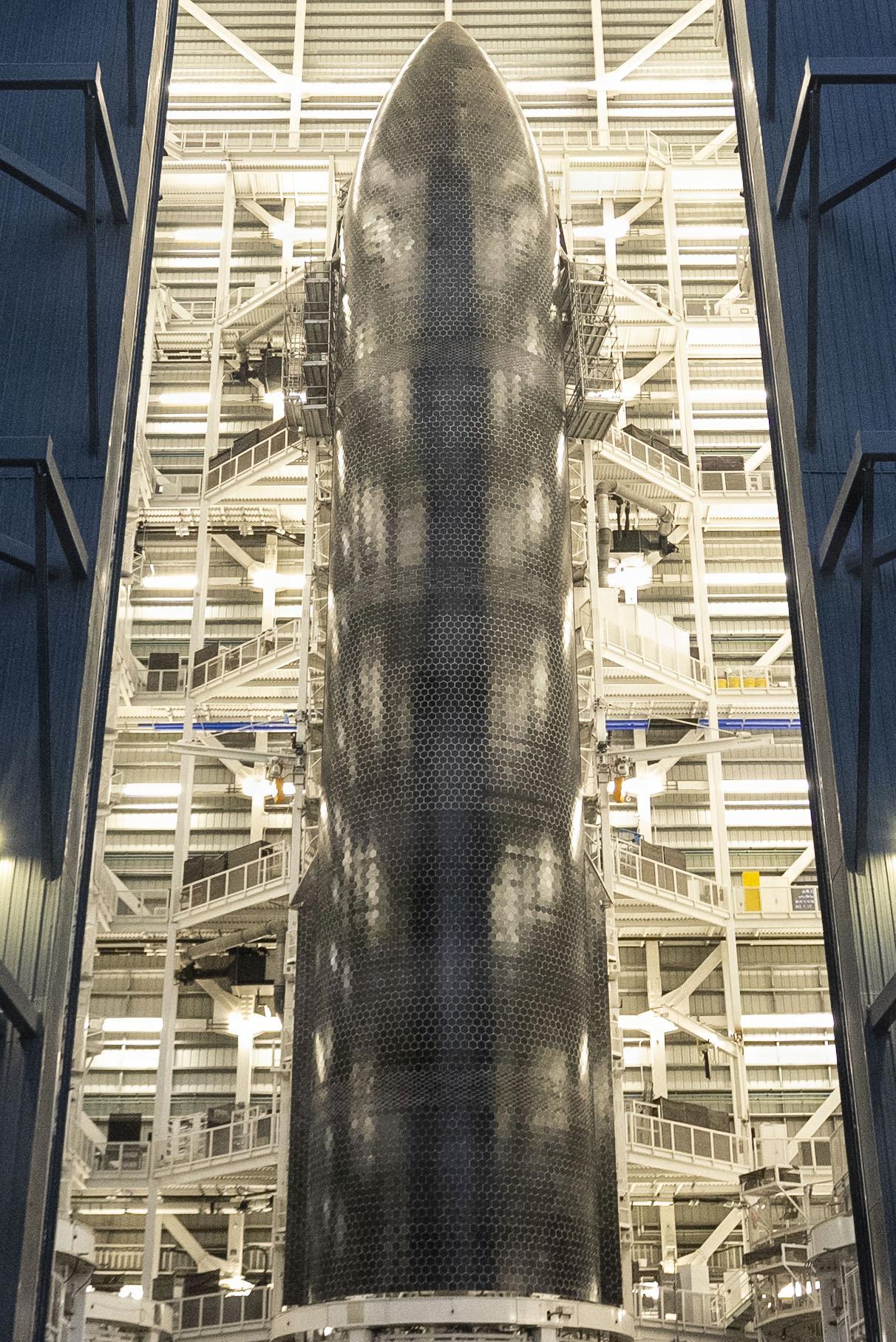
Ship 39 inside a Starbase assembly building, showing the tiled heat shield. This is an earlier vehicle, not Flight 15’s upper stage. Photo: Petty Officer 1st Class Alexander Kubitza / U.S. government; public-domain source and existing crop.
How this builds on Falcon 9 and the Space Shuttle
Reusable spacecraft are not new. NASA’s Space Shuttle returned its orbiter, including its main engines, and recovered its solid rocket boosters for refurbishment. Its large external propellant tank was expended. That history matters: Starship’s ambition builds on decades of experience with hardware that survives spaceflight. NASA’s account of the Shuttle external tank
Falcon 9 made booster reuse a regular part of orbital launch operations, but its upper stage is not designed for recovery or reuse. SpaceX states that distinction explicitly in its prospectus. Starship aims to extend recoverability across both main stages of the launch system. SpaceX’s prospectus, filed with the SEC
| System | Hardware recovered for reuse | What Starship is trying to extend |
|---|---|---|
| Space Shuttle | Orbiter and solid rocket boosters; external tank expended | Recovery of both main powered stages in a different vehicle architecture |
| Falcon 9 | First-stage booster; upper stage expended | Recovery of the stage that reaches orbit |
| Starship’s intended operating model | Super Heavy and the Starship upper stage | Repeated flights of both stages with affordable preparation between missions |
Recovering both stages would demonstrate a major capability. Establishing their useful flight life, turnaround time and operating cost would require further missions.
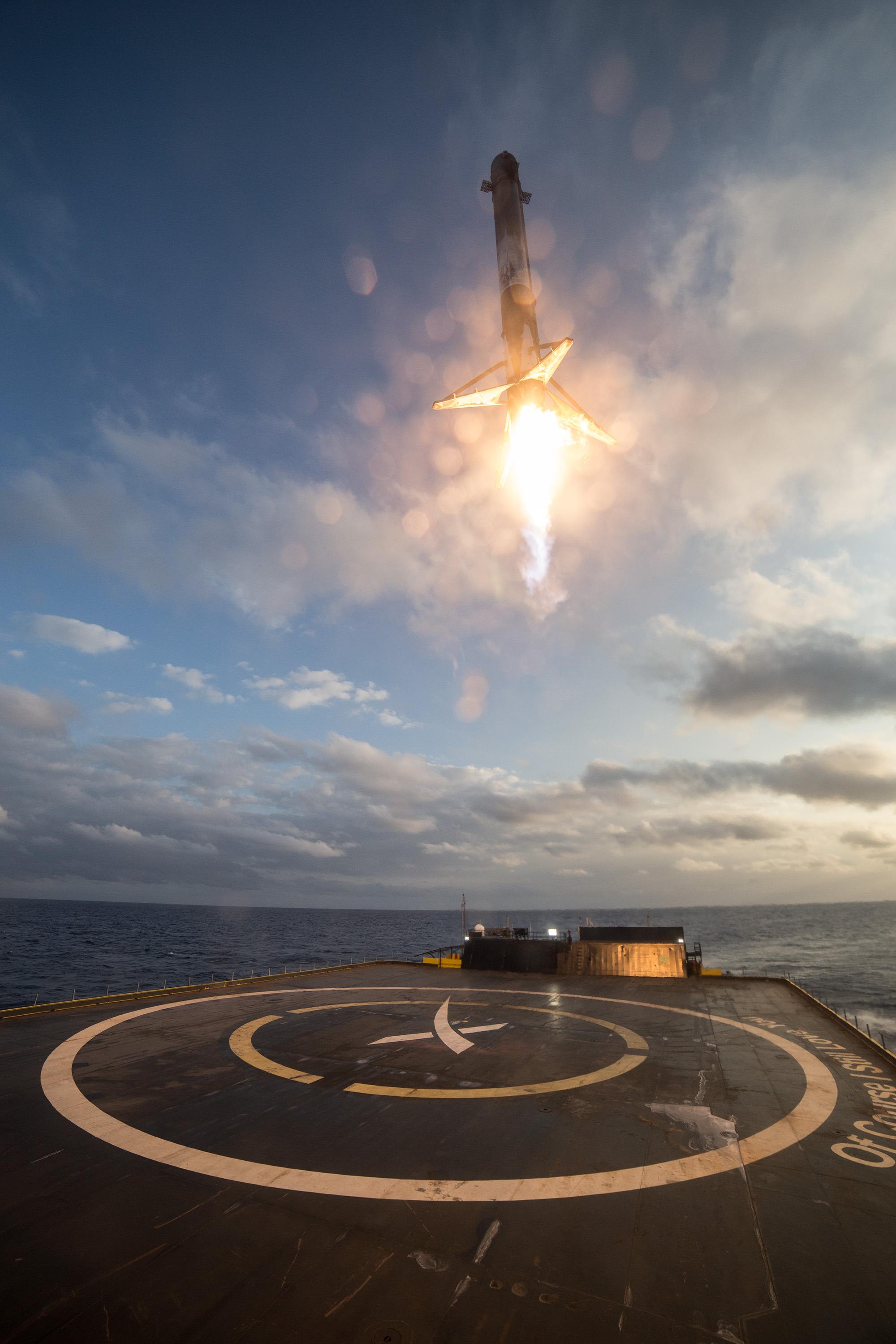
Falcon 9 returns to a droneship during the SES-10 mission on March 30, 2017, the first reflight of an orbital-class Falcon 9 booster. Photo: SpaceX, CC0.
Why recovering both stages could change the economics
The basic economic argument is straightforward. A rocket that is discarded must recover its manufacturing cost from one flight. A vehicle that flies repeatedly can spread that construction cost across many missions.
Consider a deliberately simplified example: if the same hardware completes 100 flights, its initial construction bill can be allocated across 100 flights rather than one. That does not make the complete launch 100 times cheaper. Fuel, inspections, repairs, replacement parts, launch-site operations, staffing and financing still have to be paid for. The example illustrates why useful vehicle life matters; it is not a forecast for Starship.
A useful way to think about the cost is:
Cost per flight ≈ hardware cost spread across its useful flights + refurbishment + propellant + operations.
Each term matters. A stage that survives but needs extensive rebuilding may offer limited savings. A reusable fleet that sits idle carries costs between missions. And the price a customer pays also depends on competition, demand and the provider’s commercial decisions.
The transformative outcome would be a combination: recover the hardware, prepare it affordably, fly it again and keep doing so reliably. Flight 15 could demonstrate an essential part of that chain. It cannot establish the entire business model in a single afternoon.
More frequent flights could change what people build
The potential benefit is broader than cheaper tickets for existing satellites. The following are implications of the reusable-transport model, rather than services that Flight 15 would immediately deliver.
Spacecraft designers could gain room to make different trade-offs. When every kilogram is expensive, teams spend heavily on reducing mass. Lower transport costs and more available capacity could sometimes make a heavier, simpler component preferable to a lighter, highly customized one. Spacecraft would still have to survive launch and function in space, but transport constraints could become less dominant.
Researchers could get more opportunities to test and improve equipment. More frequent affordable launch opportunities could support experiments that iterate through multiple versions. A failed experiment would still hurt, but a shorter wait for another flight could change which risks a university or small company can accept.
Larger projects could become easier to supply. Stations, telescopes, servicing vehicles and exploration missions all depend on transporting equipment. Greater available launch capacity could make some projects more practical, although they would still need funding, engineering and customers.
For Nepal and other countries with smaller space programs, the potential opening is participation: research partnerships, instruments, Earth-observation projects and student missions. Lower launch costs alone would not create that access. Local expertise, affordable payload services, ground systems and access to data would still determine who benefits.
The Moon connection: Reusable launches as a supply chain
NASA’s current Starship lunar architecture shows why flight frequency matters. Its October 2026 update describes tanker Starships delivering cryogenic propellant to a depot in Earth orbit, which then supplies the lunar lander. A lunar expedition therefore depends on a sequence of launches and transfers, not simply one large rocket leaving Earth. NASA also requires an uncrewed lander demonstration and certification before crewed missions. NASA’s October 23 lander-development update
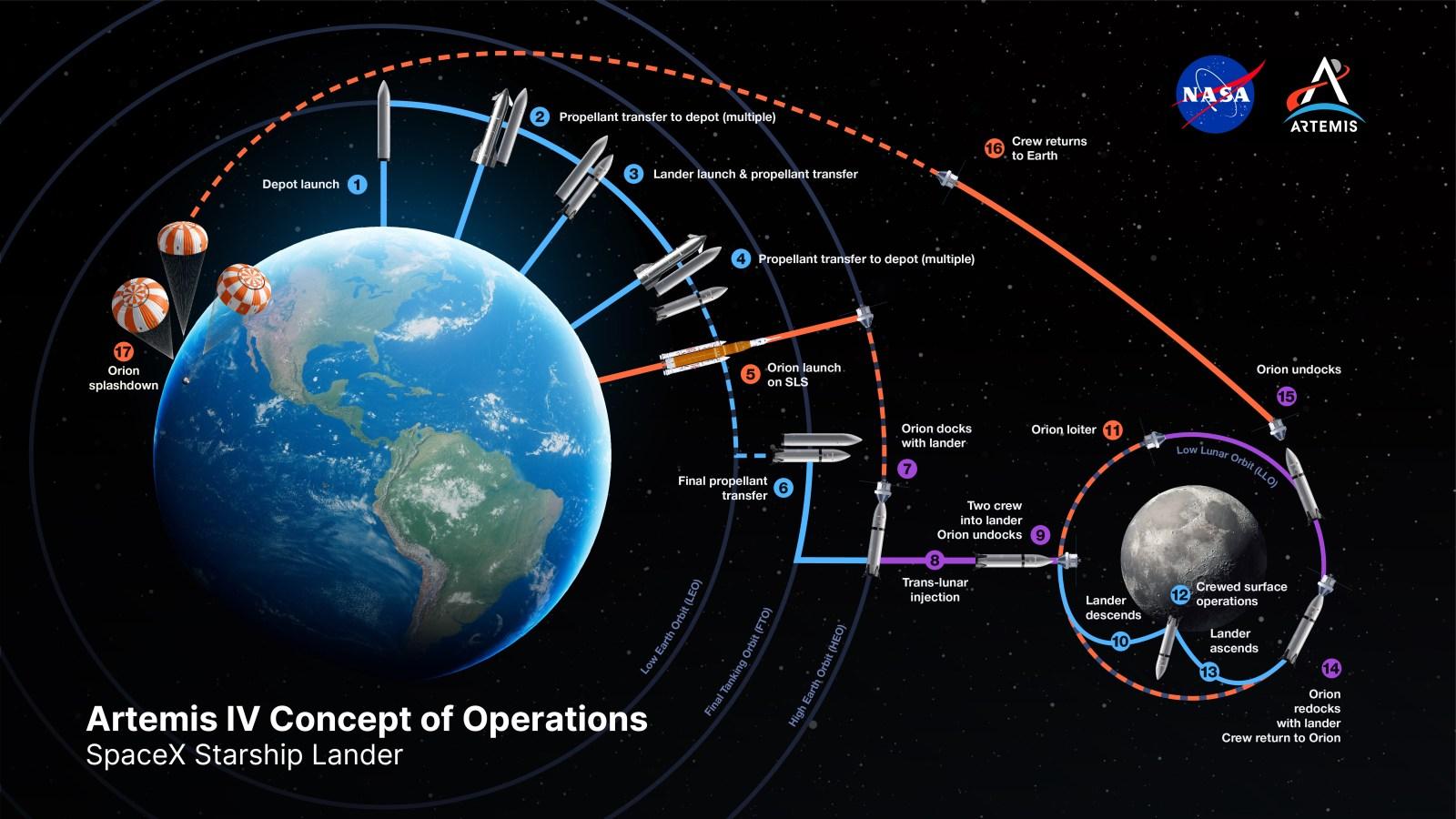
NASA’s October 2026 Artemis IV concept of operations illustrates the repeated launches and propellant transfers behind a lunar mission. This is a proposed mission architecture, not a record of completed flights. Diagram: NASA, U.S. government work.
The implication is powerful: an affordable reusable launch fleet could serve as the transport layer for repeated deliveries of propellant and equipment. That is the foundation of a sustained supply chain beyond Earth. But recovering Starship on Earth does not demonstrate ship-to-ship refueling, long-term propellant storage, lunar landing or the safety of carrying astronauts. Those remain separate capabilities to prove.
What would make this a turning point—and what comes afterward
A double recovery would unite two difficult achievements in one mission: the booster’s return and the orbital stage’s controlled return. Engineers could then inspect the hardware, compare its condition with flight data and establish what needs replacement before another launch.
SpaceX itself identifies durable heat shields, rapid refurbishment, reliable returns and supporting infrastructure among the challenges to its intended flight rate. Its prospectus warns that failing to achieve full reusability or rapid turnaround would mean higher costs and slower deployment. SpaceX’s risk disclosures
The launch site also has to support the pace safely. FAA records make clear that launch and reentry operations require authorization and review of public safety and environmental effects. More recoverable vehicles do not automatically mean unlimited flights. FAA’s Starship project record
For viewers, the milestones to watch are therefore sequential:
- Complete the planned orbital mission. Recovery is valuable alongside successful delivery of the mission’s objectives.
- Bring both main stages back safely. This would demonstrate the recovery capability at the center of Starship’s design.
- Inspect the returned hardware. Its condition determines how much work separates recovery from reuse.
- Refly the same stages. A second flight provides stronger evidence of a useful reusable vehicle.
- Repeat with predictable cost and turnaround. This is where an engineering milestone becomes a transport service.
That is why Flight 15 could be pivotal. The prospect of recovering both stages challenges one of spaceflight’s most expensive habits: replacing major flight hardware after each mission. Success would give humanity stronger evidence that a very large orbital transport system can come home with its main stages preserved.
The deeper change would follow when those stages fly again, and then again—making space access more frequent, more affordable and available to a wider range of missions. A successful double recovery could be the moment that future begins to look practical.
Editorial note: This article is a prelaunch analysis. It distinguishes announced plans, demonstrated achievements and potential future benefits. Photographs show earlier vehicles and missions; the NASA diagram describes a proposed architecture. No photograph depicts a completed Flight 15 recovery.