
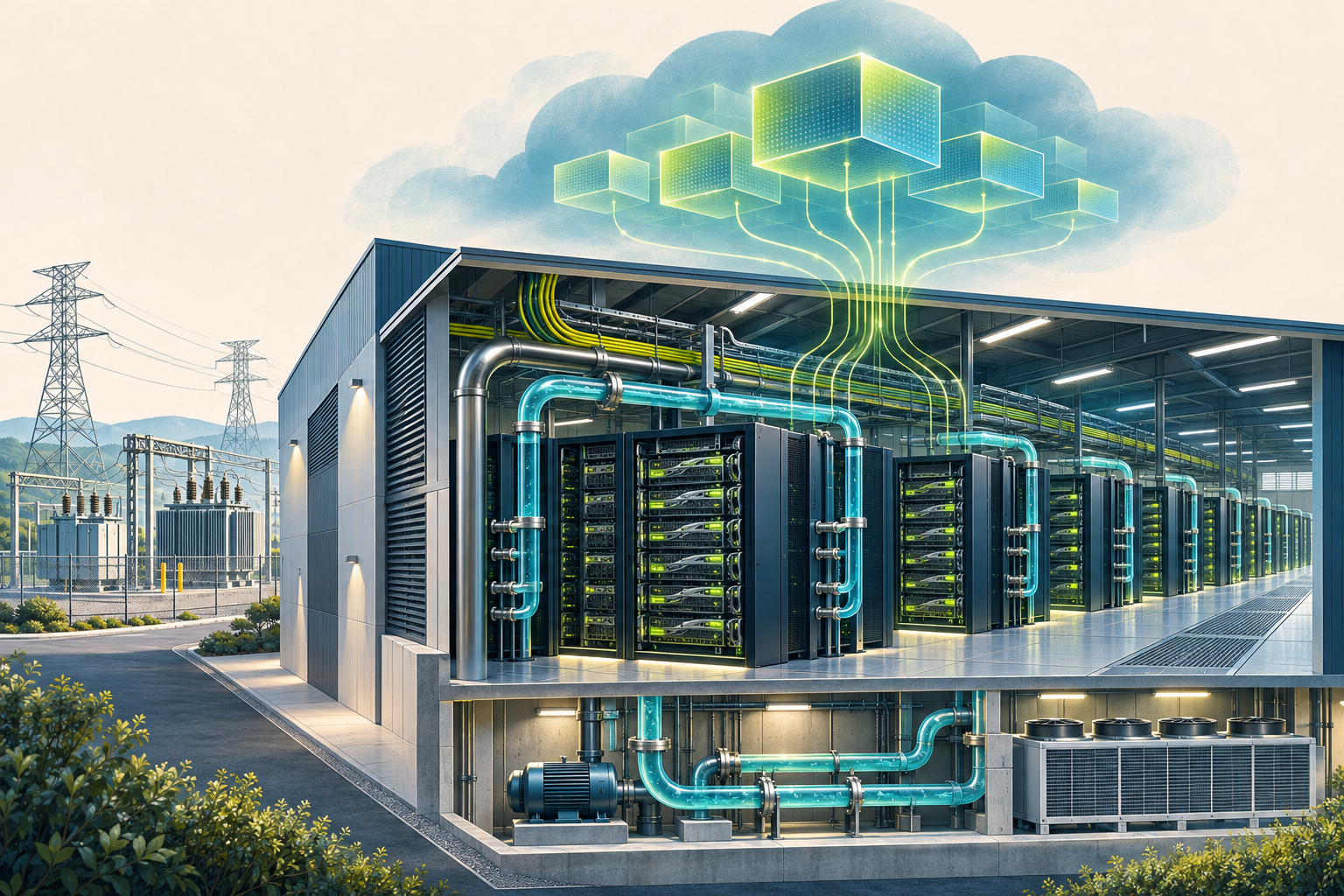
AI-generated editorial illustration; this does not depict a particular company’s facility.
Nvidia sells the chips. Neoclouds turn those chips into computing services that AI companies can rent. Between the two sits a demanding business: securing electricity, building data centers, financing expensive hardware, and keeping that hardware earning enough to cover its costs.
That makes neoclouds one of the most interesting—and financially demanding—ways to invest in AI infrastructure. A large contract can establish years of demand. It can also require the provider to spend heavily before the first bill is paid.
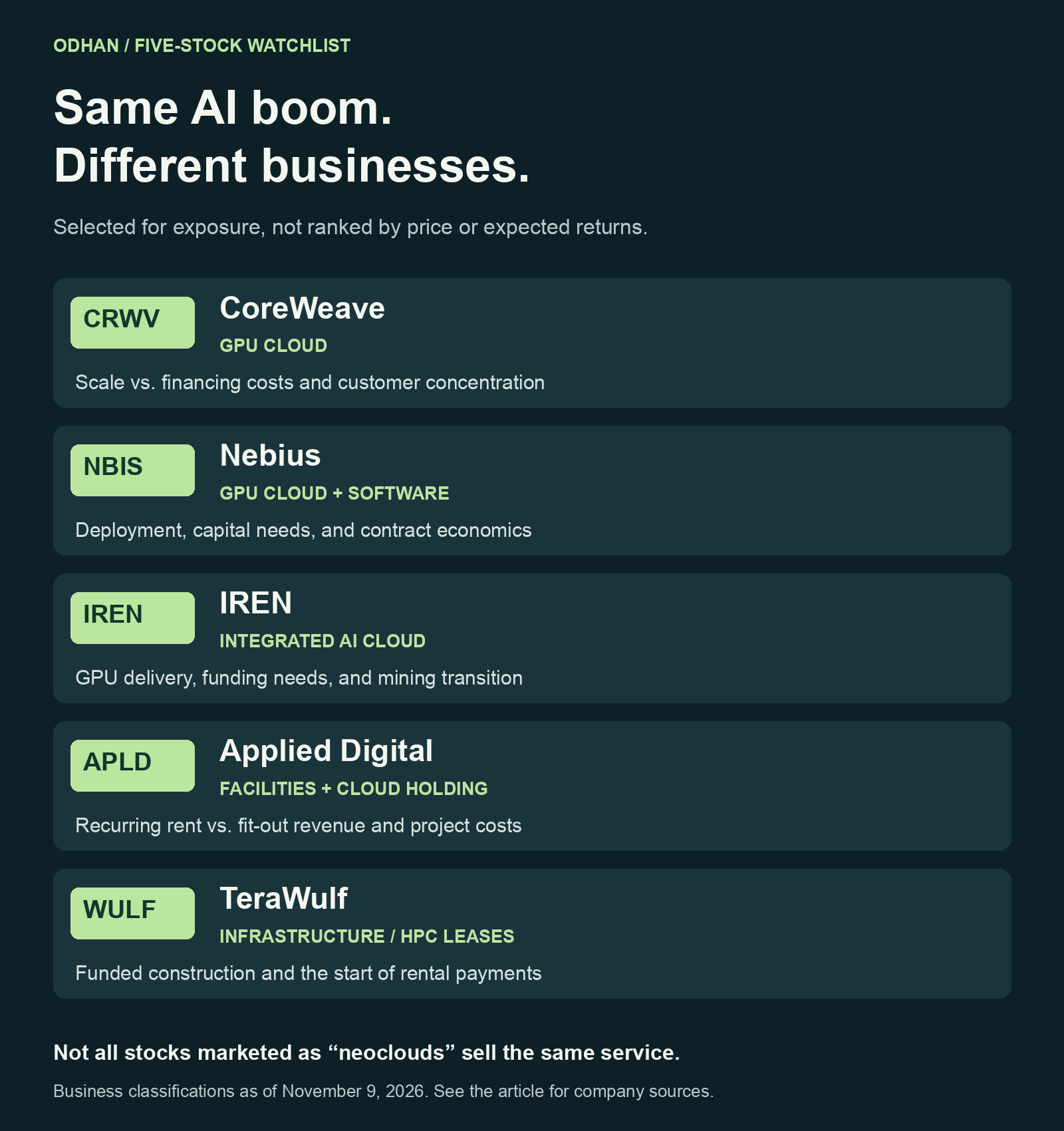
This guide explains the business, the numbers that matter, and five stocks worth understanding: CoreWeave (CRWV), Nebius (NBIS), IREN (IREN), Applied Digital (APLD), and TeraWulf (WULF). These are an editorial watchlist selected for meaningful exposure and different business models, rather than a ranking by market value or expected returns. The last two offer substantial infrastructure exposure; they should not be treated as interchangeable with GPU cloud operators.
What is a neocloud?
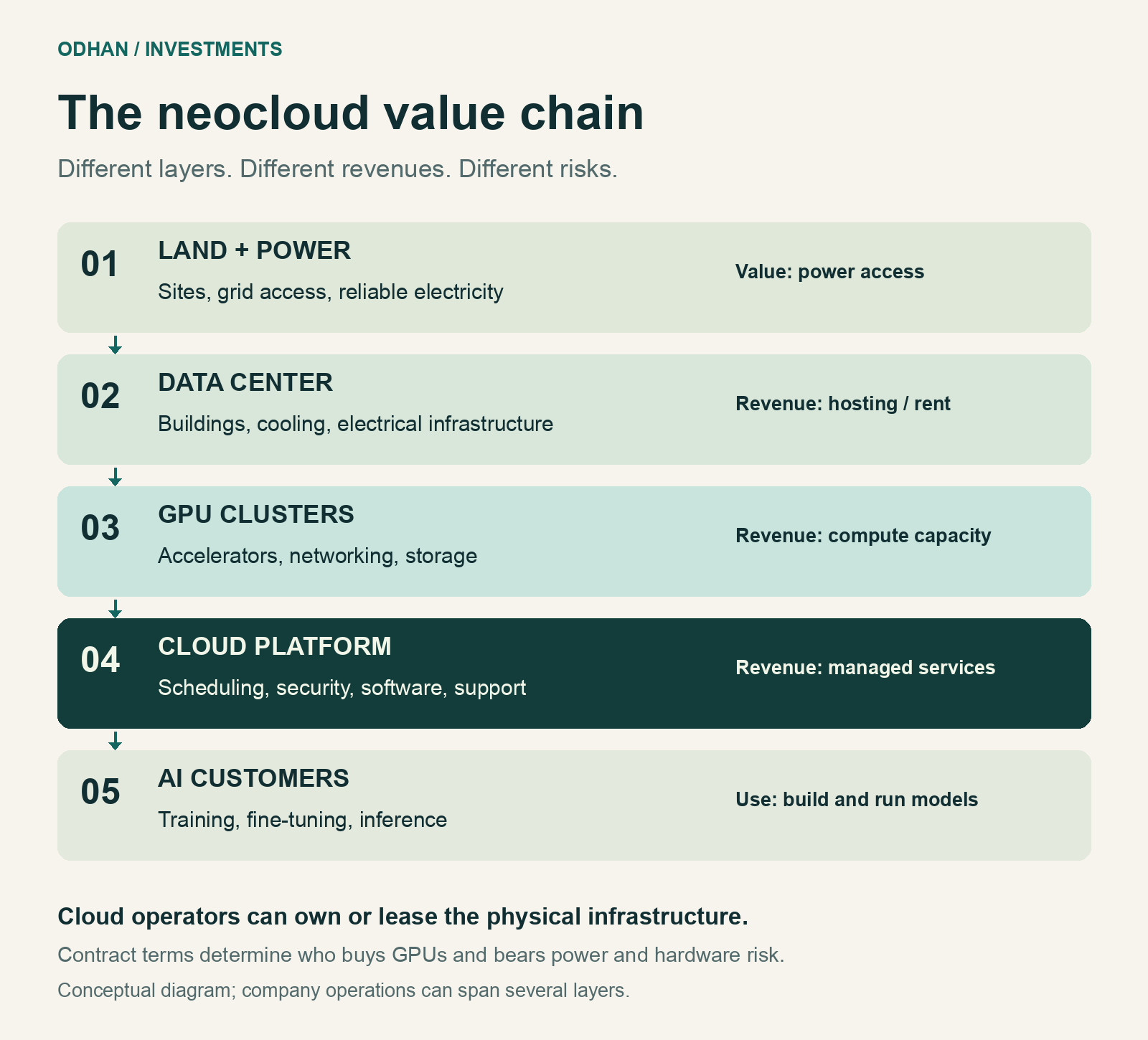
A neocloud is a cloud provider built around accelerated computing, especially GPUs used for AI. Customers rent access to computing capacity instead of buying and operating the entire system themselves. The term describes a business model, rather than a formal stock-market sector. Microsoft’s explainer describes the specialist GPU-first providers behind this category.
A useful analogy is a commercial kitchen. Nvidia supplies the high-performance ovens. A data-center developer supplies the building, electricity, and cooling. The neocloud equips and operates the kitchen, schedules access, and charges customers to use it. Some businesses own several layers; others rent the building or outsource parts of the stack.
The service goes beyond owning chips. Large AI jobs need GPUs connected by fast networks, storage that can feed them data, and software that schedules work and detects failures. A cluster with frequent downtime can be less valuable than a smaller system that delivers reliable performance. Nebius’s compute documentation illustrates the infrastructure customers actually provision.
Why customers rent this capacity
Customers use GPU clouds for training, which builds a model; fine-tuning, which adapts it; and inference, which runs it to produce results. Requirements for networking, latency, memory, and location differ. GPU-hours are not perfectly interchangeable. Nvidia’s explanation.
Renting can let a customer start sooner, vary its capacity, and avoid managing the whole hardware stack. Neoclouds compete through available capacity, engineering, software, service, and price. AWS, Azure, and Google Cloud also supply accelerated computing and have broader ecosystems; neoclouds do not have an automatic performance or cost advantage for every workload. Microsoft’s overview discusses this specialist-versus-general-purpose distinction.
Big Tech can be both customer and competitor; suppliers can also be investors. Check the relationships behind contracts before treating announcements as independent demand.
How the business makes—and loses—money
GPU operators sell on-demand usage, reserved capacity, dedicated clusters, or managed services. Infrastructure providers may instead earn rent for powered, cooled data-center space. Their obligations differ: the contract determines who buys and refreshes GPUs, pays for electricity, and bears the cost of idle equipment.
Consider a hypothetical fleet of 1,000 GPUs, with a realized price of $2 per billed GPU-hour and 80% billable utilization over 30 days. Revenue would be $1.152 million: 1,000 × $2 × 720 hours × 80%. At 60% utilization, it would fall to $864,000, before any price change. Much of the financing and facility cost would still be due. These are illustrative assumptions, not current GPU rental prices or company forecasts.
Revenue must cover electricity, cooling, maintenance, staff, facilities, interest, and hardware replacement. Owning land and power improves control but commits capital. Depreciation is an accounting expense; the economic question is the equipment’s remaining earning life and replacement cost.
Four distinctions prevent expensive misunderstandings:
- Backlog versus revenue: backlog describes future contracted business under a company’s definition. Delivery conditions, timing, and customer credit still matter. It is not cash in the bank.
- ARR versus annual revenue: annualized recurring revenue is a run-rate measure. Multiplying one month by 12 does not mean that amount has already been earned over a year.
- Adjusted EBITDA versus cash available to shareholders: EBITDA excludes interest, taxes, depreciation, and amortization; company adjustments can exclude more. It does not pay for a new GPU fleet or settle financing obligations.
- Power secured versus capacity earning revenue: a planned site, a grid connection, an energized building, commissioned GPUs, and a billable service are separate milestones. Facility power also differs from critical IT load, the power available to computing equipment.
Five stocks at a glance
All five trade on Nasdaq. Prices below are US-dollar regular-session closing quotes for November 9, 2026. They identify the market snapshot, rather than indicate which stock is cheaper on a valuation basis. Revenue periods differ and should not be compared as though they were the same quarter.
| Company / ticker | Exposure | Nov. 9 close | Reported revenue snapshot | Key issue to monitor |
|---|---|---|---|---|
| CoreWeave / CRWV | GPU cloud platform | $48.98 | $2.575 billion; Q2 2026 | Interest burden and backlog conversion |
| Nebius / NBIS | GPU cloud and AI software platform | $141.45 | $582.3 million; Q2 2026, consolidated | Deployment, funding, and contract economics |
| IREN / IREN | Integrated AI cloud, with remaining mining revenue | $21.41 | $228 million; Q1 FY2027 | GPU deployment and remaining capital needs |
| Applied Digital / APLD | Data-center development and hosting; cloud subsidiary | $16.72 | $341.9 million; Q1 FY2027 | Recurring rent versus fit-out revenue |
| TeraWulf / WULF | Power-backed infrastructure and HPC leasing | $12.38 | $76.2 million; Q3 2026 | Construction, financing, and rent commencement |
Price references: CRWV, NBIS, IREN, APLD, WULF. Financial sources and qualifications follow below. All monetary figures are in US dollars unless stated otherwise.
1. CoreWeave (CRWV): scale meets a demanding financing model
CoreWeave provides a purpose-built AI cloud, making it a direct way to study the economics of rented GPU infrastructure. In Q2 2026 it reported revenue of $2.575 billion, up approximately 112% year over year, and a net loss of $626 million. Net interest expense was $640 million. Its adjusted EBITDA margin was 59%, a useful illustration of how a strong adjusted operating measure can coexist with a substantial net loss. Q2 results.
The company’s quarterly filing reported that its three largest disclosed customers represented 36%, 26%, and 10% of quarterly revenue—72% combined. Diversification was improving from the prior-year comparison, but concentration remained material. Q2 Form 10-Q.
CoreWeave reported approximately $104 billion of backlog at June 30, excluding more than $25 billion of new commitments added early in Q3. Its definition includes amounts beyond remaining performance obligations and is subject to service delivery and availability requirements. Backlog definition.
Investment case: scale, customer relationships, and software can support repeat business. Main risk: debt, concentration, and delivery costs can absorb the value of that growth. Watch revenue delivered per unit of capital, interest coverage, and cash after investment. Q3 results are scheduled for November 10, 2026; this November 9 snapshot does not assume their outcome. Company announcement.
2. Nebius (NBIS): a full-stack AI platform with a large buildout
Nebius sells an AI cloud spanning infrastructure and software. Its listed parent also includes other businesses and equity investments, so consolidated results are not identical to pure GPU cloud results. Q2 2026 group revenue was $582.3 million, up 454% year over year. Net loss from continuing operations was $190.4 million. The quarter included approximately $5.6574 billion of purchases of property, equipment, and intangible assets. Q2 financial disclosure.
The Meta agreement announced in March illustrates the importance of reading contract structure. It comprises $12 billion of dedicated capacity plus an arrangement for Meta to purchase additional available capacity up to $15 billion over five years. The latter capacity can also be sold to other customers. The headline “up to $27 billion” should not be treated as revenue already earned or an unconditional payment received today. Meta agreement.
Investment case: engineering and managed software may build a more durable customer relationship than bare GPU rental. Main risk: large spending commitments must become reliable, profitable services before financing and competitive pressures erode returns. Watch commissioned capacity, customer prepayments, cash commitments, and recurring AI cloud economics. Q3 results are scheduled for November 12, 2026. Investor hub.
3. IREN (IREN): an integrated AI cloud replacing its mining profile
IREN combines land, power, data centers, and GPU cloud services. In the quarter ended September 30, 2026—Q1 FY2027—AI cloud revenue reached $200 million out of $228 million total revenue, approximately 88%. Bitcoin mining contributed $28 million. The company reported a $263 million net loss, despite positive adjusted EBITDA of $66 million. Revenue backlog was $20.3 billion. Q1 FY2027 results.
Its deployment schedule deserves close attention. Management moved its target for more than $4 billion of contracted ARR from year-end 2026 to January 2027, potentially February, citing a customer-requested change and supplier timing. That target is not revenue already recognized. The same release described approximately $15 billion of remaining planned FY2027 capital spending, supported by $9 billion of cash and committed financing/prepayments, with another $6 billion of targeted funding still subject to market conditions. Funding and timing disclosures.
Investment case: control of physical infrastructure can support expansion and delivery. Main risk: a growing AI revenue base does not remove construction, GPU procurement, funding, or dilution risk. Watch delivered clusters, collection of customer payments, and the distinction between committed financing and financing still being sought.
4. Applied Digital (APLD): understand the landlord—and the revenue mix
Applied Digital is primarily a developer and operator of AI-capable data centers, with cloud exposure through majority-owned ChronoScale, whose results are consolidated. It is therefore broader than a pure GPU rental company. Q1 FY2027, ended August 31, 2026, produced $341.9 million of revenue and a $221 million net loss attributable to common shareholders. Quarterly results.
Its HPC hosting revenue of $262.6 million included $65.8 million of base rent, $183.5 million of tenant fit-out services, and $13.3 million of tenant recoveries. Fit-out revenue comes from preparing space for tenants; it should not automatically be annualized as recurring rent. Company non-GAAP measures also exclude ChronoScale, making reconciliations important. Revenue breakdown.
As of August 31, leases covered about 1.41 GW of critical IT load, representing approximately $36 billion of base-term contracted revenue across several campuses. Those commitments stretch over years and include capacity still under construction. CoreWeave is the tenant at Polaris Forge 1. Contracted portfolio.
Investment case: successful construction can turn power access and land into recurring rental income. Main risk: completion costs, financing, tenant concentration, and corporate/subsidiary complexity. Watch base rent, delivery dates, debt service, and the cash attributable to common shareholders after financing partners are paid.
5. TeraWulf (WULF): power and HPC leasing become the main story
TeraWulf owns and develops power-backed digital infrastructure. Its Q3 2026 revenue was $76.2 million, including $63 million of HPC lease revenue, approximately 83% of the total. At September 30 it had 102 MW of revenue-generating critical IT capacity at Lake Mariner, with another 336 MW under construction. Q3 results.
Its reported net income of approximately $709.9 million benefited from a non-cash warrant fair-value change, while adjusted EBITDA was negative $12.8 million. The accounting profit therefore should not be read as the cash-earning power of the rental business. Financial qualifications.
The company also disclosed a 20-year Anthropic lease for approximately 401 MW, representing about $19 billion of base-term contracted revenue. Planned service dates run from late 2027 through Q2 2028. Google’s credit support covers certain Anthropic obligations; examine its scope rather than assume it removes every project risk. Lease and credit support filing.
Investment case: delivered facilities can generate durable lease income. Main risk: the gap between signing a long contract and completing a financed, revenue-producing project. Watch rent commencement, capital costs per delivered MW, restricted cash, debt, and remaining mining exposure.
How to judge valuation across these stocks
A lower share price does not make a business cheaper. Start with enterprise value, generally equity market value plus debt and other relevant claims minus cash; then adjust carefully for leases, restricted cash, minority interests, and project structures. Compare that with realistic revenue and cash flows on a consistent basis.
For GPU operators, test utilization, realized pricing, hardware refresh costs, and operating cash flow after the required investment. For landlords, focus on stabilized rent, tenant credit, maintenance spending, financing costs, and the ownership share of each project. Avoid comparing one company’s future ARR target with another’s historical revenue as if they were equivalent denominators.
A useful downside test is: what happens if capacity arrives six months late, realized prices fall 20%, or refinancing costs rise? Model the effects separately and together. For long-term fixed-price contracts, immediate pricing risk may be lower, but renewal terms, delivery obligations, and customer solvency still matter. Those are analytical scenarios, not forecasts.
Owning several names also does not guarantee diversification. For example, Applied Digital’s CoreWeave leases link a landlord’s cash flow to a company an investor may already own. Shared chip suppliers, lenders, customers, and electricity constraints can make a basket more correlated than the ticker count suggests.
What would make the investment thesis stronger?
Look for a chain of evidence: secured power → completed facilities → commissioned hardware → billed revenue → collected cash → returns after financing and replacement costs. A strong business repeatedly moves through that chain while preserving value per share.
The central questions: can CoreWeave’s scale outrun financing costs; Nebius turn its platform into durable cash generation; IREN deliver while closing funding needs; Applied Digital grow recurring rent; and TeraWulf complete its contracted facilities on schedule?
The AI compute boom can create valuable companies. The investment opportunity depends on who captures the cash after the chips, buildings, lenders, and customers have all been paid.
Editorial note: this is an educational investment watchlist, not a forecast of the best-performing stocks. Company-reported figures, contract values, and targets are identified separately. Research and price snapshot: November 9, 2026, after the U.S. regular-session close. The scheduled CoreWeave and Nebius results were not yet available at that cutoff. Category: Investments.