Researched 10 November 2026. This article concerns the 26 August 2026 Rasuwa–Bhotekoshi–Trishuli disaster. Figures below retain their reporting dates; they are not a live disaster dashboard.
The Bhotekoshi disaster began in the high mountains and rapidly became a crisis across a connected river valley. On 26 August 2026, a collapse involving rock and glacier ice near the Nepal–China border generated a destructive flow that struck the border area and travelled downstream through the Bhotekoshi–Trishuli system. Communities faced a combination of bereavement, missing relatives, destroyed crossings and interrupted livelihoods. The recovery now extends far beyond clearing debris: families need secure housing, functioning services and a transparent route to assistance.
Early descriptions called the event a glacier collapse. Subsequent scientific work describes a cascade involving rock, ice, sediment and floodwater. A research preprint reconstructing the event examines how the initial slope failure developed into a channelled disaster. Its findings should be read as research subject to revision rather than a final official inquiry.
Which Bhotekoshi flood?
Dates and locations matter. Nepal has experienced several disasters associated with the name Bhotekoshi, and photographs from different years should not be treated as interchangeable.
On 8 July 2025, a separate flood struck the Lende/Bhotekoshi corridor at Rasuwagadhi. Nepal’s NDRRMA situation report associated it with the rapid drainage of a supraglacial lake on Tibet’s Purepu Glacier. The destruction of the border bridge disrupted an important trading route. The August 2026 disaster followed a different initiating event; it should not simply be described as a repeat of the same lake outburst.
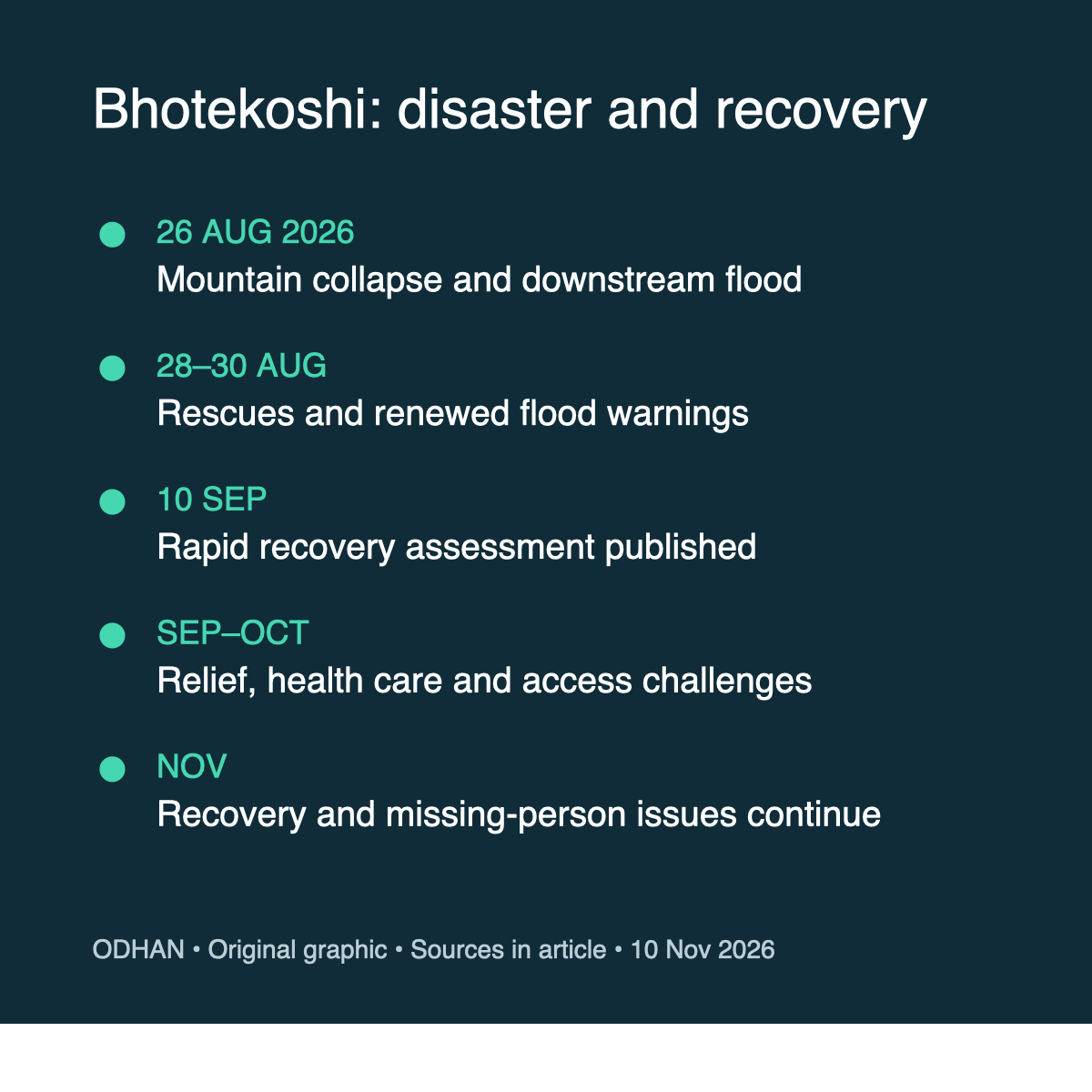
Timeline: from mountain collapse to a prolonged emergency
The following sequence separates the immediate disaster from later reporting and recovery milestones. Nepal times are used where specified.
| Date | Incident or milestone | Why it matters |
|---|---|---|
| 8 July 2025 | Earlier glacial-lake-related flood damages the Rasuwagadhi corridor. | Establishes the region’s recent disaster history without merging two events. |
| Morning, 26 August 2026 | Rock and glacier ice collapse; a destructive flow strikes the border corridor and moves downstream. | The emergency crosses administrative and international boundaries. |
| 28 August | AP reports helicopter rescues, survivors pulled from mud and concern about a newly formed upstream lake. | Search and rescue proceeds under continuing flood risk. |
| 30 August | Authorities issue fresh flood warnings after increased upstream water flow. | The first surge does not mark the end of danger. |
| 31 August–9 September | INF Nepal records healthcare and relief work in Rasuwa and Nuwakot. | The response expands into sustained support for displaced communities. |
| 10 September | A rapid assessment puts reconstruction and recovery needs at approximately NPR723.31 billion. | Rebuilding becomes a long-term national financing challenge. |
| 17 September | An independent crowdfunding tracker stops updating its cross-platform totals. | Its figures become a historical snapshot, not a current balance. |
| 25 October | RRN’s two-month review documents continuing access, shelter and service needs. | Emergency assistance and reconstruction overlap. |
| 9 November | OnlineKhabar reports unresolved missing-person records and delayed relief. | Administrative recognition remains part of the recovery crisis. |
The rescue and renewed-warning entries draw on AP’s 28 August report and 30 August report. The November development is reported by OnlineKhabar.
The human toll: why dated figures matter
A missing-person list and a confirmed death count describe different realities. They must never be added together and presented as confirmed fatalities. Identification, duplicate reports and people re-establishing contact can change the figures.
RRN’s two-month update cites Nepal Police figures of 1,457 deaths and 4,720 missing as of 10 October, while also recording a different NDRRMA reporting series. These are dated Nepal figures, not a combined Nepal–Tibet total or a verified count for 10 November. The differences underline the need for careful reconciliation. For affected families, that work also influences documentation, eligibility for assistance and the possibility of beginning a more secure life.
What was damaged—and what the recovery estimate means
The Kathmandu Post’s 10 September account of the rapid assessment reported damage to 69 kilometres of roads, 33 motorable bridges washed away and four more partly damaged. Thirteen hydropower projects were affected, alongside solar facilities. The assessment also recorded damage to private homes, schools and health facilities.
The estimated NPR723.31 billion recovery requirement is a planning estimate. It is not money already raised, approved or spent. Restoring infrastructure also requires decisions about future exposure: replacing a crossing or service in a vulnerable location can recreate the conditions for another loss.
For households, these large figures translate into practical problems. A broken crossing separates people from school, markets and treatment. A damaged water network increases the work of obtaining safe water. Electricity and communications failures complicate both daily life and the distribution of assistance.
Recovery: reaching people beyond accessible distribution points
Recovery has progressed unevenly. INF Nepal’s response update says its funded activities directly reached approximately 475 households between 31 August and 9 September, while medical teams assessed and treated 264 people. Its wider partnership response reached about 950 households. These are overlapping descriptions of programme reach and should not be added together as separate beneficiary totals.
RRN’s two-month review describes a persistent logistical challenge: communities with difficult access could receive less assistance than places near functioning roads. Its October field work included medical supplies, household support and psychosocial assistance. Such organisation-reported activities document work undertaken; they do not establish that every affected community has received adequate help.
The next stage needs to connect temporary shelter with durable housing, restore services and support earnings. Schools and health facilities matter alongside roads and power plants. Families with missing relatives also need consistent information and workable assistance procedures. As winter approaches, the quality and location of shelter become increasingly consequential.
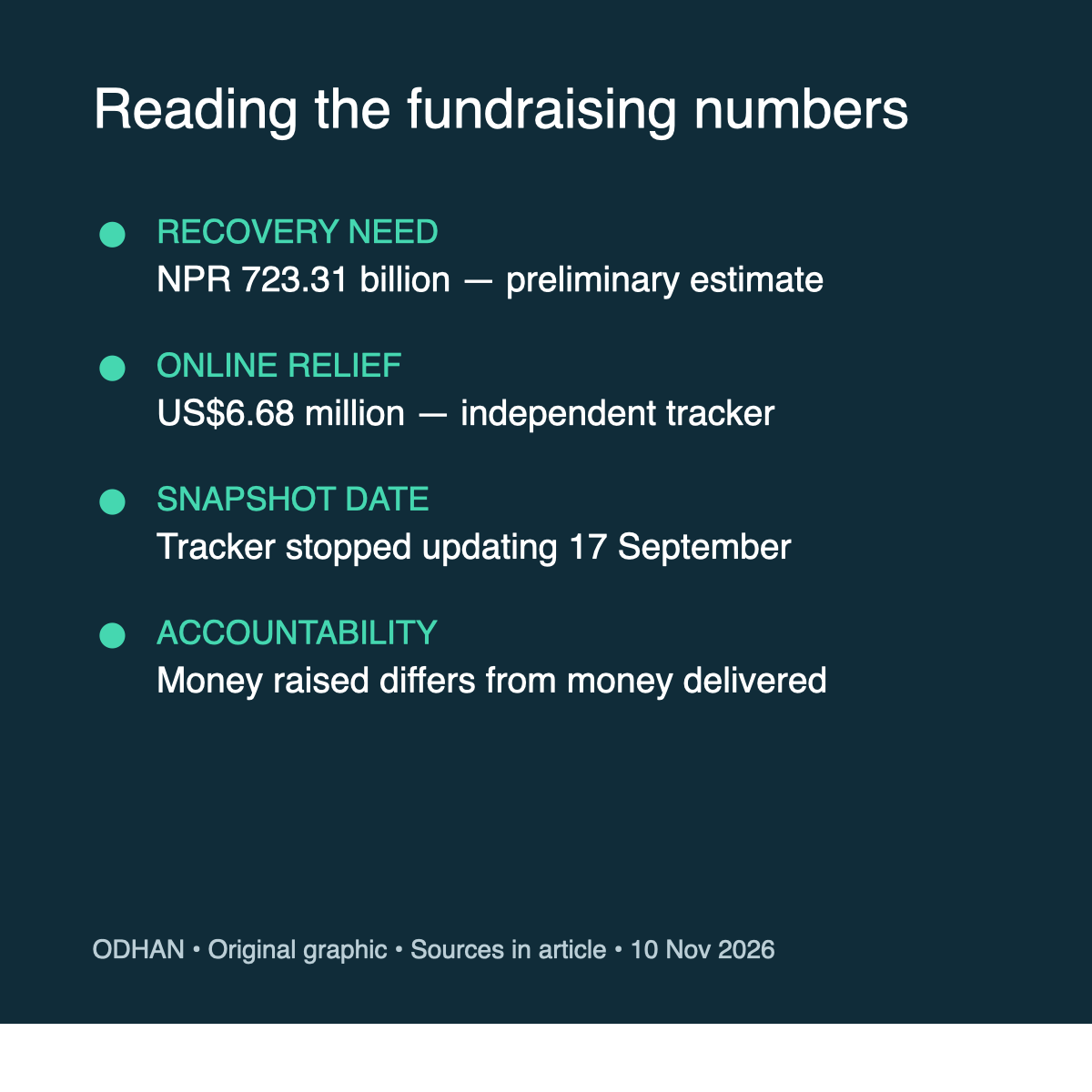
Crowdfunding: solidarity, with limits on what totals can tell us
The response has included diaspora fundraising, charity appeals and donations across many platforms. These channels can move money toward urgent household needs, but campaign totals do not automatically show how much reached survivors.
Amarnepal’s independent fundraiser tracker reports US$6,676,748 across 1,800 counted relief campaigns on 26 platforms, with updates ending 17 September 2026. Its classification separates relief campaigns from personal or family campaigns and other excluded entries. This is the tracker’s historical aggregate, not an audited sector-wide total, and later donations may be absent. It must not be combined casually with government relief balances or agency pledges.
One directly accessible example is the St. James’s Place Charitable Foundation appeal on JustGiving. At the research check, the page displayed £2,916 plus £719 Gift Aid. Its stated purpose is emergency aid and recovery following the August disaster. The page establishes what the organiser says and what the platform displays; it does not independently prove final expenditure or beneficiary delivery. Amounts can change.
Readers considering a donation should check the named organiser, intended recipients, transfer arrangements, platform charges and recent delivery updates. A useful update identifies what was provided, where, when and through which local partner. Donation receipts and distribution records answer different questions, and both help establish accountability.
What to watch next
The most useful recovery measures are concrete: how many households obtain safe shelter, which communities regain dependable access and water, when children return to suitable learning spaces, and whether families can obtain assistance without unresolved documentation holding them back.
The Bhotekoshi flood demonstrates how a sudden mountain failure can become a long social and economic emergency downstream. Rescue saves lives in the first hours. Recovery depends on sustained public investment, locally informed distribution and a clear accounting of what promised support actually delivers.
Editorial note: This is a synthesis of linked reporting, research and responding organisations’ updates, not original field reporting. Casualty figures, programme reach and campaign balances have different dates and methods. The accompanying original explanatory graphics summarise the reporting; they are not photographs of the disaster.